Workspaces, workflows and runs
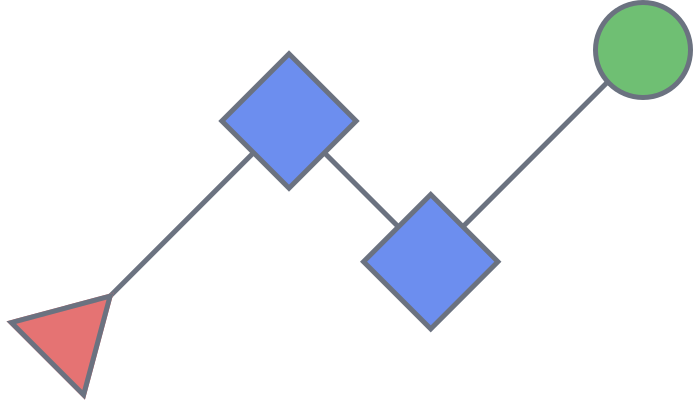
Three kinds of things, each with its shape, as in the logo and in pictures of a workflow: ● a workflow, ■ an action and ▲ a connector, where messages come from.
A workspace is a folder with an itero.config.json. One daemon runs one
workspace:
itero.config.json the manifest: what it is, port, limits, and each workflow, action and connectorworkflows/order.json ● a workflow: its name is its file nameactions/check-payment ■ an action: an executable, its name its file nameconnectors/mail.received ▲ a connector: its messages are of this type.itero/ the journal, the log and each workflow's memoryworkflows/, actions/ and connectors/ may have subfolders, to group files
any way you like: workflows/shop/order.json, actions/mail/imap-check.
A name stays its file name, unique within its kind: two workflows of one
name are an error naming both files, but an action and a workflow may share
one (#ship and ship). Hidden folders and node_modules are never
looked into. itero which says where a name is.
● A workflow says when it runs (on) and what it does (steps):
{ "on": [{ "event": "order.placed" }], "steps": [["#check-payment", "#check-stock"], "order-process", "#send-mail"] }■ An action (#check-payment) is a small program. It reads its values
as environment variables, prints JSON, and its exit code says how it
went. A workflow can be a step too (order-process).
A message has a type, two or more words joined by dots
(order.placed), and data. Apps send them with itero emit or POST /events; connectors print them. A message starts a run of every workflow
whose on has an event of its type. A schedule or a change to a
watched file starts runs too.
A run is one go through a workflow, with an id and a name of two
random words (misty-lake). It has a state: the data of the message
that started it, plus what each step printed. A step that is
not ready yet (exit 75) makes the run wait until a message for it
arrives. A run ends as done, failed (the state says
"success": false) or error (something broke).
The daemon runs the workspace, one per workspace. When something happens (a message arrives, a schedule comes due, a watched path changes, a waiting run’s timer fires) it makes a pass, at once or within a second:
itero daemon (one per workspace)│├─ connectors and watched paths: beside it, feeding messages in│└─ every pass: 1. messages → start new runs, wake waiting runs 2. runs → decide each run's next steps 3. steps → run each step's action, side by side (up to 8 at a time), each as its own process 4. results → saved; they are the next pass's inputA run moves through its workflow’s steps:
run: started ─► step ─► step ─► … ─► success / failure / error list ─► ended │ └─ exit 75: waiting ─► (a matching message, or the hourly retry) ─► the step againEvery arrow is written to the journal (.itero/journal.sqlite) before it
happens, so a daemon that stops carries on where it was, with nothing
lost and nothing done twice. What it did is in the log,
.itero/itero.log (The log, IDs and names).
Names at a glance:
| Written | Is |
|---|---|
#check-payment |
an action |
order-process |
a workflow |
{"event": "order.placed"} |
a message type in on |
{"schedule": "0 9 * * *"} |
a schedule in on |
{"path": "inbox"} |
a watched file or folder in on |
$order |
a value in the run’s state |
$$API_KEY |
an environment variable or a secret |